We are paid when readers call a provider through this site. That never changes our advice. How we make money
Quick answer
Mitigation is the emergency phase: stopping the water, extracting it, removing what cannot be saved, and drying the structure so the damage stops growing. Restoration is the repair phase that follows: new drywall, flooring and paint to put the home back the way it was. Mitigation is priced mostly by the square foot and the type of water; Fixr's January 2025 guide puts water extraction at $3.75 to $7.50 per square foot. Homeowners policies such as the sample HO-3 form expect you to protect the property from further damage, which is why mitigation usually starts before the adjuster arrives.
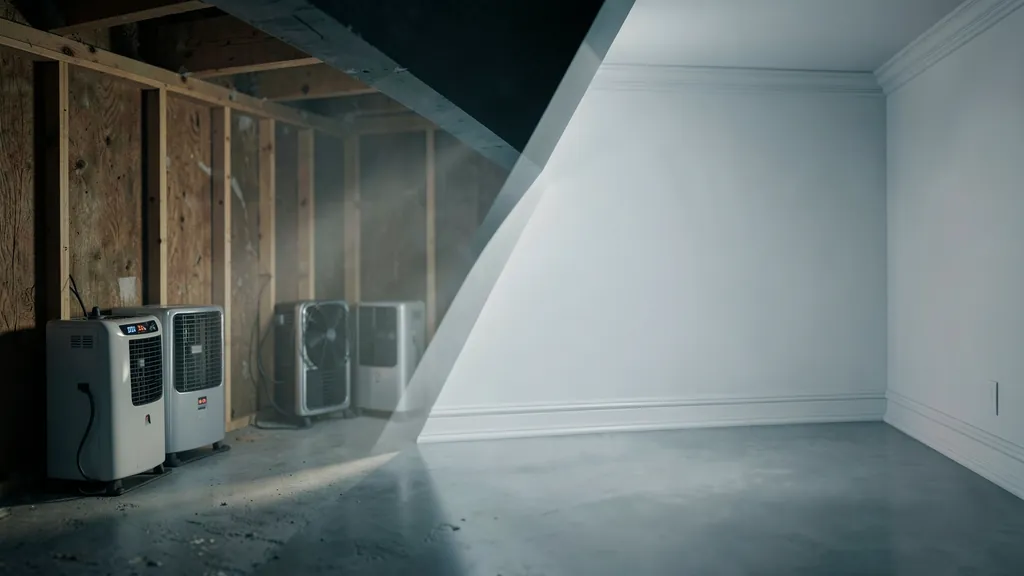
Do this first: stop the damage from growing
Whatever you call the work, the first hours are the same. Mitigation is mostly about time: wet materials dried within 24 to 48 hours usually do not grow mold. [1]
- Stop the water at the source or the main shutoff valve.
- Keep out of water near outlets or the electrical panel; turn the power off only from a dry spot, and if you would have to enter water to reach the panel, call an electrician to turn it off. [2]
- Take photos and videos of the damage. [3] Do it before you move anything if you can.
- Remove pools of water and start drying to prevent more damage and mold growth. If you cannot remove the water and dry the area yourself, use a service. [4]
- Make only temporary repairs to protect the house; do not make permanent repairs until your insurance company has seen the damage, and keep receipts. [4]
- Call your insurer right away; the time you have to report a claim varies by state. [3]
What is water mitigation, and what is restoration?
Cost guides split a water damage job into two phases. Fixr describes them as water extraction and cleanup first, followed by structural repairs, and prices the first phase in tables titled Water Extraction Cost by Type of Water and Water Mitigation Cost by Class. [5] On this page, mitigation means that first phase and restoration means the repairs that follow.
The words are not used consistently, so read every quote carefully. Bob Vila's cost guide uses restoration for the whole process, from removing the water to restoring the property to its pre-loss condition. [6] Fixr also says the term water damage restoration covers both the extraction and the repairs. [5] A third word, remediation, is used loosely too: Fixr calls water remediation the process of cleaning up, drying out, sanitizing, and restoring or rebuilding materials and surfaces after water damage. [5] Ask any company which phase its price covers.
| Mitigation | Restoration | |
|---|---|---|
| Goal | Stop the damage from getting worse | Put the home back the way it was |
| When | First hours and days | After the structure is dry |
| Typical work | Water extraction, removing wet carpet, pad, drywall and insulation, drying equipment, cleaning and disinfecting | Drywall, insulation, flooring, trim, cabinets, paint |
| Who does it | A water damage restoration company | The same company or a general contractor and trades |
| How it is priced | Per square foot, by type of water, volume, equipment used and affected area (Fixr, January 2025) | By the repair: materials and labor for each item |
| Insurance angle | Your policy expects you to protect the property from further damage | If the loss is covered, paid as part of the claim, minus your deductible |
What mitigation includes, and when it is a job for a pro
- Water removal: pumps and extraction vacuums for standing water and soaked carpet.
- Removing what cannot be saved: carpet and pad that cannot be cleaned and dried quickly, and drywall and insulation contaminated with sewage or floodwater. [7]
- Drying: air movers and dehumidifiers, with moisture readings taken until materials reach a dry standard.
- Cleaning: surfaces cleaned and, for dirty water, disinfected.
- Records: photos, moisture readings and equipment logs your adjuster can use.
The type of water changes everything. Category 1 is clean water from a source like a broken supply line. Category 2, gray water, includes washing machine discharge and sump pump failures. Category 3, black water, includes sewage and flooding from ground surface water. [8] If the damage was caused by sewage or other contaminated water, EPA says to call in a professional experienced in cleaning buildings damaged by contaminated water. [1]
What water mitigation costs
Mitigation is priced mainly by how much area is wet and how dirty the water is. Fixr's water damage guide, updated January 31, 2025, puts water extraction at $3.75 to $7.50 per square foot, depending on the volume, equipment and affected area. [5]
| Measure | Fixr, Jan 2025 | Bob Vila, May 2023 |
|---|---|---|
| Clean water (Category 1), per sq ft | $3.75 to $4.25 | $3 to $4 |
| Gray water (Category 2), per sq ft | $4.10 to $6.50 | $4 to $6.50 |
| Black water (Category 3), per sq ft | $7 to $7.50 | $7 to $7.50 |
| Class 1 job (small area, minimal absorption) | $150 to $400 | $150 to $400 |
| Class 2 job | $500 to $1,000 | $500 to $1,000 |
| Class 3 job | $1,000 to $3,000 | $1,000 to $3,000 |
| Class 4 job (large area, likely structural issues) | $20,000 to $100,000 | $20,000 to $100,000 |
Sources for the table: Fixr's January 2025 guide [5] and Bob Vila's May 2023 guide, which notes its per-square-foot black water price covers removal and drying only, with repairs and replacements extra. [6] For a basement, Fixr's January 2025 flooded basement guide puts cleanup at $2,000 to $7,000, with a national average of $4,000, or $3.50 to $7.25 per square foot. [9]
What drives the price: the water category, the volume of water, the equipment used and the affected area, Fixr's January 2025 guide says, plus how much material has to be torn out. Fixr adds that extraction and drying take at least three days. [5] Waiting makes it worse: wet materials left past 24 to 48 hours can grow mold, which adds removal work. [1]
What restoration costs, on top of mitigation
Restoration is the repair bill, and it is usually separate from the cleanup bill. Fixr's January 2025 basement guide says repairs after a basement flood range from $75 to $15,000, in addition to the cleanup and water removal cost. [9]
- Whole job, both phases: Fixr's January 2025 guide puts water damage restoration at $1,200 to $5,000, with a national average of $3,000, from $350 for an overflowing toilet to $50,000 for black water extraction, drying, cleanup and drywall and hardwood floor replacement after a sewer backup in a basement. [5]
- Older figures: Bob Vila's May 2023 guide, citing Angi and HomeAdvisor, gave $1,305 to $5,707, with an average of $3,455. [6]
- Typical repair items: Bob Vila's May 2023 guide puts most structural repairs at $1,500 to $10,000 and ceiling repairs at $350 to $1,250. [6]
For full price tables by room, material and job size, see water damage restoration cost. For the basement guides, see the basement water guide.
How insurance treats mitigation and restoration
Homeowners policies generally make protecting the property your job. In an older sample Insurance Services Office HO-3 form (HO 00 03 10 00) posted by the Insurance Information Institute, your duties after a loss include protecting the property from further damage, making reasonable and necessary repairs to protect it, and keeping an accurate record of repair expenses. [10] The same form pays the reasonable cost of necessary measures taken solely to protect covered property from further damage, and it excludes loss from neglect to use all reasonable means to save and preserve property at and after the time of a loss. [10]
- Do not wait: Washington's insurance regulator warns that insurance won't cover water damage if you delay repairs. [11]
- Temporary, not permanent: make temporary repairs and keep receipts, but hold off on permanent repairs until your insurer has seen the damage. [4]
- The cause still decides coverage: most policies cover sudden and accidental water damage, such as a burst pipe or a broken washer hose, and usually not gradual leaks. [4]
- Your deductible comes off the top: in the Insurance Information Institute's example, a $500 deductible on a $10,000 insured loss leaves a claims check of $9,500. [12] For minor damage, you might decide to pay for repairs yourself. [3]
How to document the job so the claim holds up is in water damage insurance claim tips, and which causes are usually covered is in does homeowners insurance cover water damage. Check your own policy; these are general patterns, not a promise of coverage.
Common questions
What is the difference between water mitigation and restoration?
Mitigation stops the damage: water extraction, removing what cannot be saved, drying and cleaning. Restoration repairs it afterward. Fixr describes the two phases as extraction and cleanup first, then structural repairs. [5]
How much does water mitigation cost?
Fixr's January 2025 guide puts water extraction at $3.75 to $7.50 per square foot, with clean water at the low end and black water at $7 to $7.50. [5] Repairs are billed on top of that. [9]
Is water mitigation covered by homeowners insurance?
When the water damage itself is covered, the sample HO-3 form, for example, requires you to protect the property from further damage and pays the reasonable cost of necessary measures taken solely to protect covered property from further damage. [10] Check your own policy and keep every receipt. [4]
Should I wait for the adjuster before starting mitigation?
No. Take photos, then remove the water and start drying; make temporary repairs but not permanent ones until the insurer sees the damage. [4] Delaying can cost you coverage. [11]
Is remediation the same as mitigation?
Not exactly. The words overlap and contractors use them differently. Fixr, for example, uses water remediation for cleaning up, drying out, sanitizing and restoring materials, which spans both phases. [5] In mold work, remediation means removing the mold. Ask each company which work its price covers, phase by phase.
Sources
- A Brief Guide to Mold, Moisture and Your Home U.S. Environmental Protection Agency, accessed October 12, 2026
- What to Do to Protect Yourself From Electrical Hazards Centers for Disease Control and Prevention, accessed October 13, 2026
- What You Need to Know When Filing a Homeowners Claim (Consumer Insight, April 20, 2022) National Association of Insurance Commissioners, accessed October 13, 2026
- When are water damage and mold covered by insurance? (last updated 4/24/2025) Texas Department of Insurance, accessed October 13, 2026
- Water Damage Restoration Cost (updated January 31, 2025) Fixr (Adam Graham), accessed November 1, 2026
- How Much Does Water Damage Restoration Cost? (updated May 30, 2023) Bob Vila (Rochel Maday), accessed November 1, 2026
- Guidelines for Cleaning Safely After a Disaster Centers for Disease Control and Prevention, accessed October 12, 2026
- Water damage guidelines (follows IICRC S500) University of California, Riverside, Environmental Health & Safety, accessed October 12, 2026
- Flooded Basement Cleanup Cost (updated January 31, 2025) Fixr (Adam Graham), accessed November 1, 2026
- Homeowners 3, Special Form, HO 00 03 10 00 (sample ISO policy form posted by III) Insurance Information Institute (sample ISO form), accessed October 13, 2026
- Leaks, water damage and mold Washington State Office of the Insurance Commissioner, accessed October 12, 2026
- Understanding your insurance deductibles Insurance Information Institute, accessed October 12, 2026
How this page was made
This guide was drafted with AI writing tools, working from the sources listed on this page. A separate fact-checking pass opened every cited source and checked each number, threshold and instruction against it; anything a source did not support was rewritten or removed. Marcus L. Barber, the publisher, then read and approved the full page, including the text, questions and answers, title, search description and images before it was published. Images are AI-generated illustrations, not photos of real homes or people.
This page has not been reviewed by a licensed restoration contractor, industrial hygienist or insurance professional. See our editorial policy. Spot an error? Email partners@digitalsolomon.com.