
We are paid when readers call a provider through this site. That never changes our advice. How we make money
Quick answer
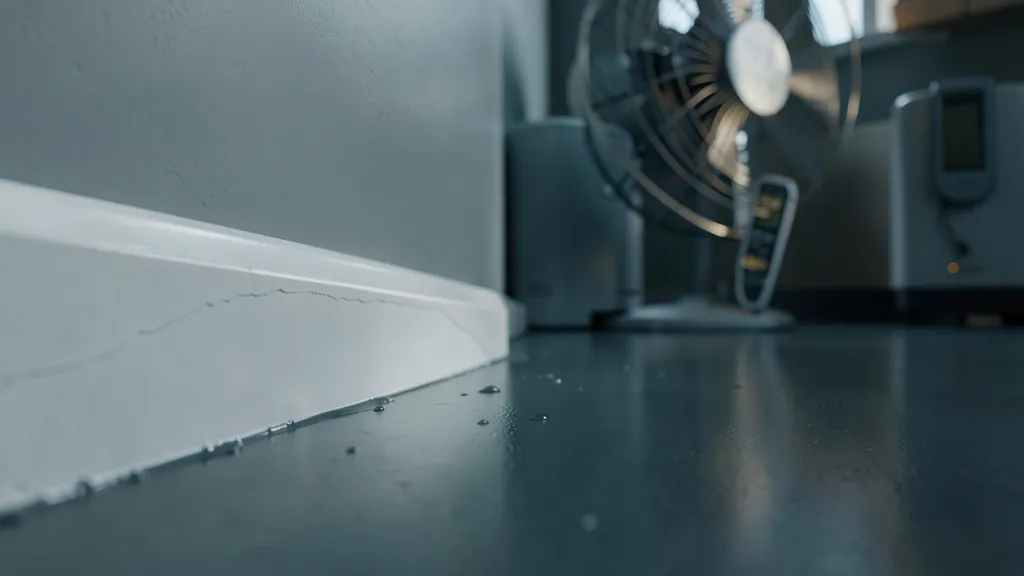
Swollen, stained or separating baseboards mean water has reached the bottom of the wall, from a leak in the wall, a fixture or appliance, a spill or flood, or rain getting in from outside. Find and stop the source first, then pull the wet section of baseboard so the wall behind it can dry; EPA says that if wet materials are dried within 24 to 48 hours, in most cases mold will not grow. [14] Solid wood trim usually goes back to its shape as it dries, but MDF that has swollen does not fully recover, so plan to replace it. [6] [7]
Do this first: stop the water and check for power
Outlets are close to the floor
If the floor or the bottom of the wall is wet near outlets or cords, do not touch them or stand in the water. Turn power off at the panel only if you can reach it from a dry spot; CDC says not to enter standing water to reach the main power switch and to call an electrician instead. [1] If the water came from a sewer backup, a toilet with waste in it or floodwater, treat it as Category 3, grossly unsanitary water containing pathogens. [2] Wear rubber boots, gloves and goggles, and keep children and pets away. [3]
- Shut off the water to the leaking fixture or appliance, or close the main valve if you cannot tell where it is coming from.
- Check for a hidden leak. Most water meters have a small low-flow dial; if it moves with all water off, you have a leak, and if it stops after you close the main valve, the leak is inside the house, more than likely a toilet. [4]
- Photograph the baseboards, the wall above and the floor before you move or remove anything. The Texas Department of Insurance says to take pictures or video before repairs and not to throw away damaged items until your adjuster has seen them. [5]
- Move rugs and furniture off the wet area, and soak up standing water with towels or a wet/dry vacuum.
- Pencil a line along the top of any stain so you can tell if it is still climbing.
What swelling, stains and gaps on baseboards tell you
Baseboards sit right where water collects, so they often show damage first. FEMA's flood guide says wallboard acts like a sponge, drawing water up above the flood level, and that wood can swell, warp or rot. [6]
| What you see | What it usually means | What to check next |
|---|---|---|
| Bottom edge swollen, puffy or split, paint cracking | The trim soaked up water. MDF swells more than solid wood and does not fully shrink back. | Check what the trim is made of and take a moisture reading. |
| Brown or yellow stain, or a tide line | Water wicked up the trim or the drywall behind it. | Look above the baseboard for stains on the drywall. |
| Gap between baseboard and wall, split caulk line | Swelling pushed the trim out, or the wall behind it is wet. | Pull a short section and look behind it. |
| Trim still damp or cool days after the spill | Water is still getting in, or the wall cavity is wet. | Run the meter test and compare moisture readings. |
| Rusted nails, rusted carpet tack strips | A slow leak is possible. Home inspectors treat rusted tack strips under loose carpet near a shower as a tip-off to a shower leak. | Look for a slow leak nearby, such as a shower or appliance. |
| Musty smell or dark spots | Mold may be growing behind the trim. | See the mold behind baseboards page before you pry. |
Table sources: FEMA, [6] the Composite Panel Association [7] and the American Society of Home Inspectors. [8] The other cells are practical checks, not proof of a cause. If you smell mold or see spots, the page on mold behind baseboards covers how to check safely and what can be cleaned.
Where is the water coming from?
Water runs along the floor and down inside walls, so the wettest baseboard is not always next to the leak. Start with whatever is on or near that wall.
- Bathroom. Home inspectors find that leaking shower pans over slab floors stain baseboards and wood trim in nearby areas, and that loose floor tile in rooms that share a wall is a red flag. [8] They also note that a stain on the ceiling below an upstairs shower can come from a defective toilet wax seal or a misused shower curtain, not only the shower. [8]
- Kitchen and laundry. NC State Extension says to check for plumbing leaks around sinks, refrigerators and dishwashers, and to check water heater and washing machine water lines. [9]
- Air conditioner. If an air conditioner's primary condensate drain line clogs, the drain pan and secondary line are supposed to handle the water, but InterNACHI says they often do not, resulting in ceiling and floor damage. [10]
- A pipe inside the wall. A meter that moves with every tap off means water is leaking somewhere; the Saving Water Partnership says a leak inside the house is more than likely a toilet, so check toilets first. [4] The burst pipe page covers what to do when a supply line breaks.
- Outside walls after rain. CDC says rainwater from gutters or the roof should drain away from the house and the ground should slope away from it. [11] NC State Extension says downspouts should extend 6 to 10 feet from the foundation. [9]
- Spills and cleaning. A pet bowl, a plant or heavy wet mopping along the same wall can do it too. These stop once the habit changes.
How to dry wet baseboards and the wall behind them
Drying the face of the trim is not enough. The water that matters is in the bottom of the drywall and the wood framing behind it. FEMA's flood guide starts its wall check by taking off the baseboard. [6]
- Score the caulk and paint line along the top of the wet section with a utility knife, then pry the baseboard off gently. Number the pieces on the back if you plan to reuse them.
- If the wall behind feels wet, FEMA's flood guide says to push an awl or knife into it about 2 inches above the floor, just above the sill plate. If water drips out, cut or drill a hole so it can drain, using a hand or cordless tool to avoid shock. [6]
- Ventilate the wall cavity. FEMA suggests drilling or cutting holes low enough that the baseboard will cover them after the wall dries, [6] and EPA says to ventilate the wall cavity if possible. [12]
- Run a dehumidifier and fans once the power to the area is safe. EPA says to remove moisture from wood immediately with dehumidifiers, gentle heat and fans, but not to use fans before you know the water is clean. [12] FEMA adds that fans may spread mold that has already started to grow. [13]
- Keep the room below 60 percent humidity, ideally between 30 and 50 percent. [14]
- Check progress with a moisture meter. Take a baseline on a dry wall elsewhere, then test the wet area and behind the baseboards, as This Old House suggests. [15] EPA says moisture meters can be used to monitor drying. [16]
- Do not reinstall, caulk or paint until the wall reads as dry as your baseline. FEMA's flood guide says not to start rebuilding until the home is completely dry. [6]
How long it takes depends on how much water got in. EPA's 24 to 48 hour window is about stopping mold. [14] Fully drying framing can take much longer; the Red Cross says that depending on the level of water damage, it can take weeks or months for structural elements to dry thoroughly. [17] Massachusetts guidance says to discard wet insulation from the wall cavity and to cut out wallboard that has not dried enough within 48 hours. [18]
Repair or replace: solid wood versus MDF
What the trim is made of matters most. A practical check: look at a cut end or the back of a piece you pulled. Solid wood shows grain, while MDF looks like uniform pressed fiber.
- Solid wood. FEMA's flood guide says a flood can bring wood's moisture content up to 30 percent, which causes swelling, but if allowed to dry naturally, wood will usually go back to its original shape. [6] EPA's water damage table says treated or finished wood surfaces may be cleaned with mild detergent and clean water and allowed to dry. [12] Once dry, solid wood trim can often be sanded and repainted.
- MDF. The Composite Panel Association, an industry group for MDF makers, says MDF swells when exposed to high humidity or water, that swelling beyond its original dimensions from high humidity is not fully recovered when it dries, and that its thickness swell is greater than solid wood's. [7] Swollen, crumbly or split MDF is usually replaced.
- Vinyl or rubber cove base. Massachusetts guidance says to remove plastic coving from the base of walls that got wet, so the wall behind can dry. [18]
- The drywall behind it. EPA says wallboard may be dried in place if there is no obvious swelling and the seams are intact; if not, remove, discard and replace it. [12]
Do not paint or caulk over any spot that has mold on it. EPA says paint applied over moldy surfaces is likely to peel. [14]
When a water damage restoration company makes sense
- The water is coming from inside the wall, or you cannot find the source.
- The wall is still wet after 24 to 48 hours. That is EPA's window for drying before mold usually grows. [14]
- The water was sewage or floodwater. CDC says to remove and discard drywall and insulation that has been contaminated with sewage or floodwater. [3]
- Several rooms or long runs of wall got wet, or water went under flooring.
- A ceiling below is stained or sagging. Stay out from under it.
- You find mold behind the trim that goes up the drywall or into the wall.
Insurance and cost
Coverage depends on the cause. Washington's insurance commissioner says homeowner insurance usually covers sudden leaks, such as leaking plumbing or a broken washing machine, but usually does not cover gradual leaks or water through cracks in walls or gaps between building materials. [19] FloodSmart, the federal flood insurance program's site, says most homeowners and renters insurance does not cover flood damage. [20] The Texas Department of Insurance says you usually must report water damage that was hidden from view within days after you first see it. [5] Read your own policy and call your insurer early.
For budgeting, Angi's July 2026 cost guide puts baseboard installation at $1,100 on average, or $5.70 to $9 per linear foot for materials and labor. Removing old baseboards costs about $50 to $100 per hour in labor, and painting adds $1 to $6 per linear foot. MDF runs about $1 to $1.40 per linear foot for material and pine about $1.40 to $1.85, with hardwoods costing more. [21] Angi's September 2026 water damage cost guide puts drywall repair at $300 to $850. [22] If the job grows into full water damage restoration, HomeAdvisor's June 2026 cost guide puts the average at $3,868, with a typical range of $1,383 to $6,369. [23] Angi says the price depends on how many feet of trim, the material, height and style, removal, painting and repairs. [21]
Renters: report the leak and the damaged trim to your landlord in writing. EPA tells renters to report all plumbing leaks and moisture problems immediately to the building owner or manager. [14]
Common questions
Can water-damaged baseboards be fixed?
Solid wood often can. FEMA's flood guide says wood swells when wet but usually goes back to its original shape if allowed to dry naturally, so it can be dried, cleaned and repainted. [6] MDF that has swollen does not fully recover, according to the Composite Panel Association, so it is usually replaced. [7]
How do you dry out wet baseboards?
Stop the water, then take the wet baseboard off so the wall behind it can dry. FEMA's flood guide checks for trapped water about 2 inches above the floor and drills holes the baseboard will later cover. [6] Use a dehumidifier and fans once the power is safe and the water is clean, and check with a moisture meter until readings match a dry wall. [12] [16]
What causes water damage on baseboards?
Common sources are leaking showers, tubs and toilets, sinks, dishwashers, refrigerator lines, washing machines and water heaters, an air conditioner drain that backs up, a pipe inside the wall, and rain getting in at outside walls. [9] [8] [10] A water meter check tells you whether water is leaking somewhere in the house while everything is off. [4]
Does homeowners insurance cover water-damaged baseboards?
Often, if the water came from a sudden, accidental leak such as a broken washing machine or leaking plumbing. Policies usually do not cover gradual leaks, and most do not cover flooding from outside. [19] [20] Photograph the damage before repairs and report it quickly. [5]
How much does it cost to replace water-damaged baseboards?
Angi's July 2026 cost guide puts baseboard installation at $5.70 to $9 per linear foot for materials and labor, and $1,100 on average for a project. [21] Drywall repair behind the trim, painting and any drying work add to that.
Sources
- What to Do to Protect Yourself From Electrical Hazards Centers for Disease Control and Prevention, accessed October 13, 2026
- Water damage guidelines (follows IICRC S500) University of California, Riverside, Environmental Health & Safety, accessed October 12, 2026
- Guidelines for Cleaning Safely After a Disaster Centers for Disease Control and Prevention, accessed October 12, 2026
- Use Your Water Meter to Check for Leaks Saving Water Partnership (Seattle-area water utilities), accessed October 12, 2026
- When are water damage and mold covered by insurance? (last updated 4/24/2025) Texas Department of Insurance, accessed October 13, 2026
- Repairing Your Flooded Home (FEMA P-234 / American Red Cross, October 2010; copy hosted by the City and Borough of Juneau, Alaska) FEMA and American Red Cross, accessed October 13, 2026
- Technical Bulletin: Dimensional Stability of Particleboard and Medium Density Fiberboard (MDF) (2023) Composite Panel Association (industry trade group for particleboard and MDF makers), accessed October 13, 2026
- Inspecting Tiled Showers and Shower Pans (Kenny Hart, home inspector and plumber, ASHI Reporter, June 1, 2003) American Society of Home Inspectors (ASHI Reporter), accessed October 13, 2026
- Mold and Moisture Checklist (April 4, 2022; adapted from University of Georgia Extension) NC State Extension (N.C. Cooperative Extension), accessed October 12, 2026
- Heating and A/C Overflow InterNACHI (International Association of Certified Home Inspectors), accessed October 12, 2026
- Safety Guidelines: Reentering Your Flooded Home Centers for Disease Control and Prevention, accessed October 12, 2026
- Mold Remediation in Schools and Commercial Buildings Guide: Chapter 4 (Table 1: Water Damage, Cleanup and Mold Prevention) U.S. Environmental Protection Agency, accessed October 12, 2026
- Dealing With Mold and Mildew in Your Flood Damaged Home FEMA, accessed October 12, 2026
- A Brief Guide to Mold, Moisture and Your Home U.S. Environmental Protection Agency, accessed October 12, 2026
- Fixing a Soggy Shower Wall (Merle Henkenius, updated May 28, 2026) This Old House, accessed October 13, 2026
- Mold Remediation in Schools and Commercial Buildings Guide: Chapter 3 U.S. Environmental Protection Agency, accessed October 13, 2026
- Disaster Cleanup and Repair For Your Home American Red Cross, accessed October 12, 2026
- Quick reference: water damage response in buildings Commonwealth of Massachusetts, accessed October 12, 2026
- Leaks, water damage and mold Washington State Office of the Insurance Commissioner, accessed October 12, 2026
- What's covered FloodSmart (National Flood Insurance Program), accessed October 12, 2026
- How Much Does Baseboard Installation Cost? (updated Jul 10, 2026) Angi, accessed October 13, 2026
- How Much Does Water Damage Restoration Cost? (updated September 11, 2026) Angi, accessed October 13, 2026
- Water damage restoration cost (updated June 17, 2026) HomeAdvisor, accessed October 12, 2026